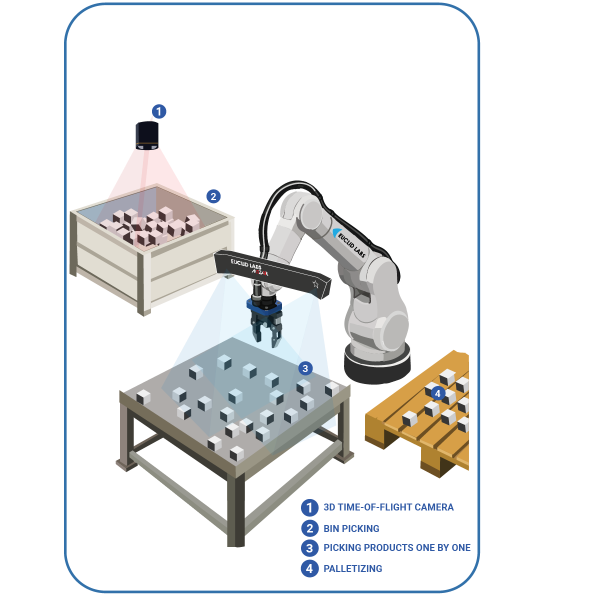





bin picking application

Moonflower

NEW BIN PICKING PARTNER PROGRAM

what is moonflower

Moonflower is a software platform for developing, deploying, and scaling bin picking applications. Designed for industrial environments, it combines advanced 3D vision, robot guidance, and application tools to automate the picking of randomly oriented parts from bins, conveyors, and other unstructured environments.

Through the Moonflower Partner Program, users gain access not only to the software, but also to continuous training, technical resources, and practical know-how that help reduce project risk, accelerate deployment, and build internal bin picking expertise.

The Partner Program includes weekly training sessions, advanced technical content, a dedicated online community, the Euclid Learning Lab, preferential conditions for purchasing perpetual software licenses, and professional support services when needed.

Built for hardware independence, Moonflower supports multiple robot brands and industrial 3D cameras, enabling seamless integration into existing production lines. Advanced grasp planning, collision-free robot path generation, object localization, and application templates help reduce deployment time and accelerate workcell replication.

PARTNER PROGRAM

A complete platform to learn, deploy, scale and get expert support when needed

FREE ONLINE TRAINING
EVERY WEEK FOR EVERYONE

Attend Moonflower's weekly live training sessions and gain the knowledge needed to independently assess whether bin picking is the right solution for your application before joining the partner program

trainingcourse

 Join The Training : Registration Form

PARTNER BENEFITS
ANNUAL PARTNER INVESTMENT

Everything you need to design, deploy, and support bin picking applications independently.

price15k

DISCOUNTED SOFTWARE LICENSE PRICE

Perpentual license with unlimmited model develpment capability.
Discounted price only available to Partner Program members.

price5k

PROFESSIONAL SERVICES PAY-PER-USE

For complex projects, new applications, or high-risk use cases, we provide dedicated consulting and support from experienced professionals.

professionalservice

KEY ADVANTAGES FOR OUR PARTNERS

FASTER DEPLOYEMENT

Autonomy and tools to enable rapid replication

COSTS UNDER CONTROL

Low software price, full transparency on services

PERPETUAL LICENSES

Each license is perpetual and allows programming an unlimited number of models

KNOW-HOW ALWAYS WITH YOU

Training and continuosly updated content always available

REDUCED RISK

Access over 20 years of experience and hundreds of installations

HARDWARE INDIPENDENCE

Freely choose the robot, 3D camera, and industrial PC that best fit your needs
what can i do with moonflower

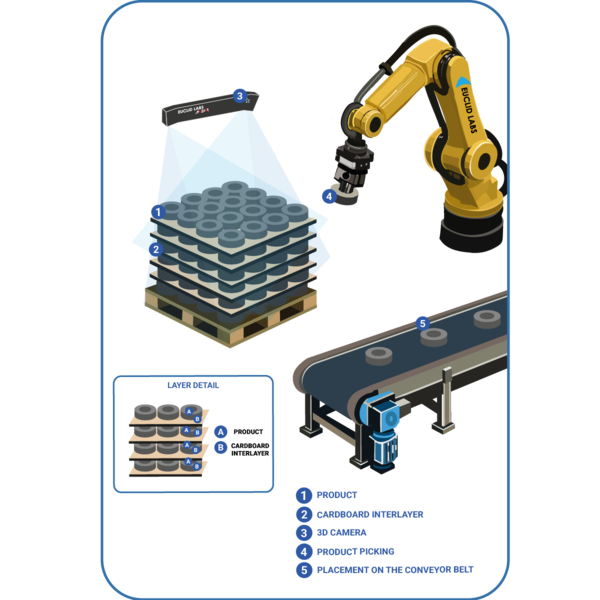
Picking from alternating layers separated by interlayers

Tavola disegno 30

Automatically detect products and cardboard interlayers, enabling reliable depalletizing and layer-by-layer picking operations.

Two-step picking for entangled parts

Tavola disegno 31

Manage complex picking scenarios where parts overlap or interlock, using intermediate placements to ensure successful separation and handling.

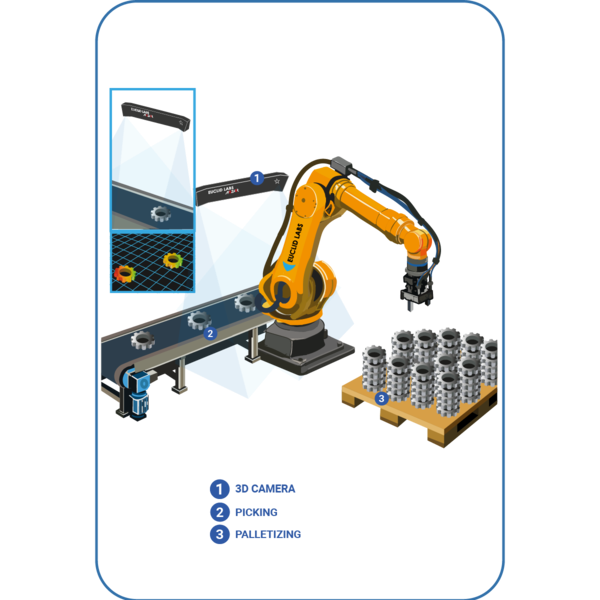
Picking parts from a conveyor with 3D positioning

Tavola disegno 32

Locate randomly positioned parts on moving or indexed conveyors and provide accurate robot guidance for downstream operations.

Picking round and rectangular billets

Handle metal billets with different geometries and orientations, ensuring reliable localization and pick generation in harsh industrial environments.

MOONFLOWER TECHNICAL CAPABILITIES 


  • Advanced 3D Object Localization
    Accurately detect and locate randomly oriented parts in complex 3D scenes.
  • Multiple Picking Positions
    Define multiple grasping strategies for the same part to maximize picking success rates across different orientations and conditions.


  • Integrated Path Planning & Simulation
    Visualize and validate robot trajectories before execution. Built-in simulation and collision-free path generation help reduce risk and accelerate commissioning.
  • Automatic Grasp Planning
    Generate reliable picking points based on object geometry and application requirements.
  • Multi-Robot Compatibility
    Deploy applications across leading industrial robot brands using the same software platform.
  • Industrial 3D Camera Support
    Choose the 3D camera that best fits your application requirements without being locked to a specific vendor.
  • Unlimited Model Development
    Create and manage an unlimited number of product models with a single perpetual license.
  • Rapid Workcell Replication
  • Reuse proven configurations and deploy applications across multiple production lines faster and with lower risk.

what is bin picking?

Strictly speaking, the bin-picking problem involves picking a part from a bin containing randomly or orderly arranged objects. However, in an industrial application, it is essential to expand the analysis to include the subsequent placement of the object elsewhere. The placement phase can significantly impact the project analysis, introducing constraints in gripper design or causing a deadly difference in cycle time.
Examining the bin picking process is crucial, as the placement aspect may pose challenges that need to be addressed. This consideration becomes particularly pertinent when contemplating the design of the gripper or assessing the overall cycle time, where even slight variations can have substantial consequences.
It is common to refer to “Robot Vision” by Berthold and Horn (MIT, 1986) as the starting point for discussions on bin picking in industrial applications .
Despite being hailed as a potential revolution, progress in robot bin picking was historically limited by the absence of 3D sensors offering the necessary resolution and speed, computational power, and expertise in tackling pose estimation and path planning challenges.

3D bin picking robot

It is evident that, while software is, at least in principle, universal, and a vision system can address a wide range of parts, the robot end effector usually needs to be designed for each specific application. Robot grasping with contact compliance is still not evolved enough to allow the use of hand-like end effectors at real application speeds.
Certainly, the need for customization can diminish the flexibility advantage of a bin picking system compared to other loaders. However, if this is the primary reason for the slow market growth, we should observe a broader range of applications in cases where designing a gripper device is more straightforward.
For example, many classes of machines are loaded with relatively symmetrical objects (such as billets in an oven for hot stamping or parts for turning centers), making it possible to create a general gripping system for them. Another clear example is a system that has to load a limited number of objects (sometimes only one) throughout its complete lifetime.
Furthermore, all semi-structured bin picking scenarios have simpler gripping requirements since only a very limited number of poses need to be handled. Therefore, there is undoubtedly a much larger market than the one currently addressed, even when considering the maximum weight associated with the end effector design challenge.

A bin-picking system is built by providing a robot workcell with:

A vision system to build a 3D image.

A software that identifies parts in a 3D point cloud, calculates a safe pick position if it exists, and plans a path there while avoiding collisions.

A gripper capable of reaching objects in a sufficient number of positions to ensure the box can be emptied.

a robot arm to perform the path.
MOONFLOWER 3D VISION SYSTEMS

The general output of a 3D camera is a point cloud.
Current 3D vision systems are usually divided into four groups: stereo cameras, structured lights, laser triangulation, and time of flight.
Euclid Labs is sharing data about the best scanners in the market on:
www.industrialrobotics.org.
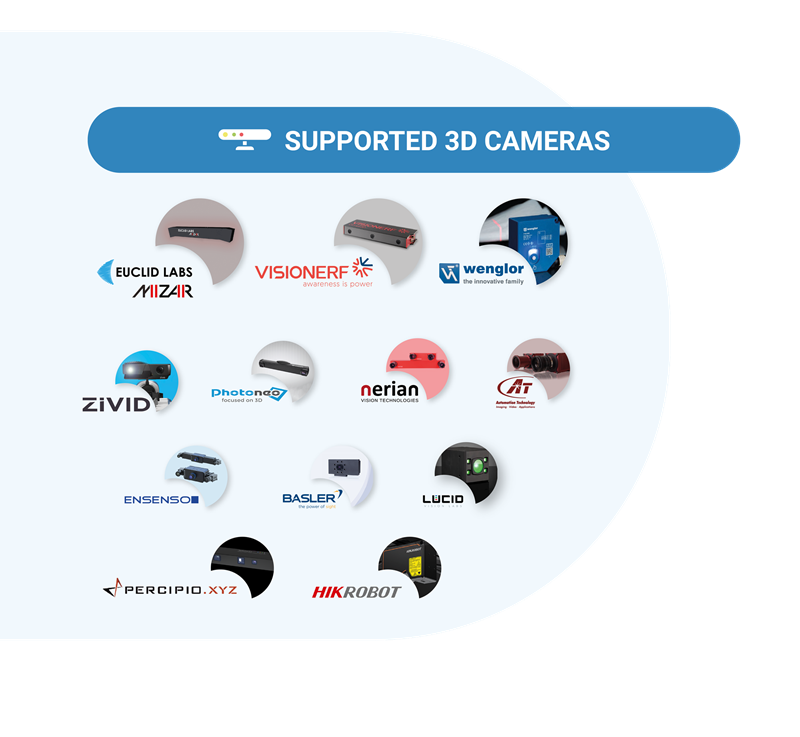
Moonflower supports a variety of different 3D vision cameras to provide the best solution in terms of performance and price for the many automated bin-picking tasks that robot integrators and OEMs are facing today.
Some examples of 3D vision systems are:

  • Keyence RB-1200: bin picking of billets in a large box.
  • Photoneo Phoxi M: bin picking of o-rings.
  • Zivid Two: localization of household appliances for automatic testing with robots.
  • Wenglor MLWL: bin picking of thin metal sheet.
  • Mech Mind LSR L: bin picking of large plastic panels.
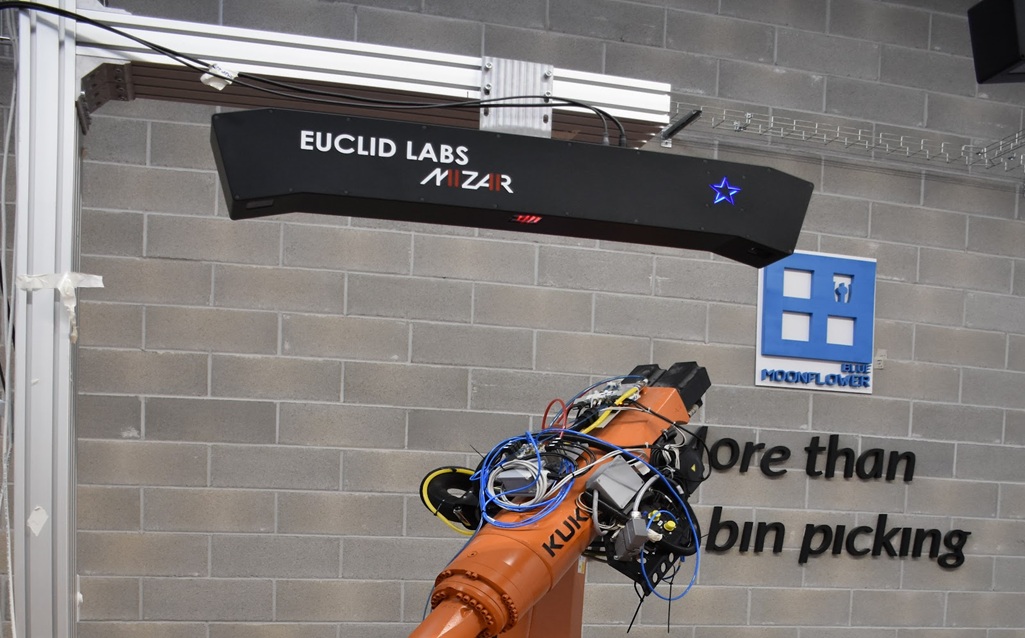
  • Mizar 1600: bin picking of large and shiny body in white components.
  • Visionerf Cirrus 1200: bin picking of automotive axis for grinding robot cell.
  • Basler Blaze: bin picking of large spherical caps.
bin picking robotics
universal robots bin picking

moonflower Gripper

Vacuum systems, magnets, and mechanical grippers are all suitable for bin-picking applications, and in some cases, they could be used simultaneously. However, a bin-picking gripper has to address some unique challenges:

  1. The volume of interference must be minimized to reduce the probability of collisions with surrounding parts in the box.
  2. The end effector must reach all box corners with the greatest freedom of orientation.
  3. There should be a method for picking in all possible poses. Another constraint arises from the deposit configuration: the gripper must match it, or the time cycle must be sufficient to allow a tool change.

Failure in gripper design will lead to deadlock conditions where parts are localized, but there are no available picking positions. If these conditions occur only at the lower corners, it may represent an acceptable limitation in terms of emptiness efficiency.


Moonflower software supports multiple grippers and multiple TCPs in each gripper.

moonflower Robot 

Many different robot brands are available, and many of them distribute arms with varying kinematics. In Euclid Labs’ bin-picking software, 6-axis robots, both puma-like and non-puma configurations, are available. External axes are optional (a linear unit may be a very practical way to extend bin numbers, typically coupled with a camera on the robot arm). Additionally, 4-axis palletizers are supported for straightforward situations where the pose is fixed.
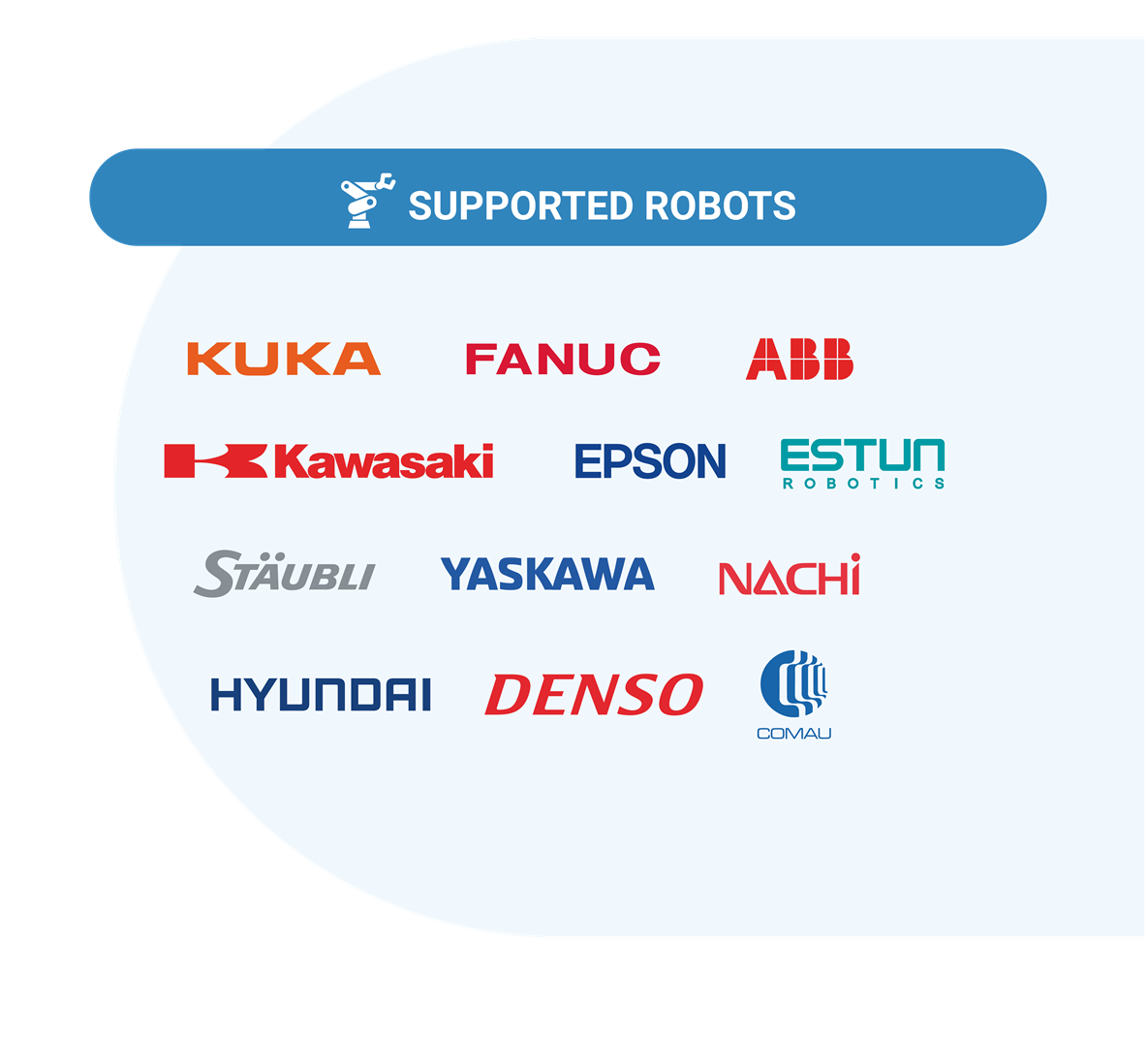
Moonflower already support different robot brands such as: Fanuc, KUKA, ABB, Staübli, Yaskawa Motoman, Denso, Epson, Nachi…


It is often undervalued how much selecting a higher payload robot can impact cycle time. In this video, the cycle time increased from 6.5 seconds to 7, 7.8, and 12.2 seconds.

Do you want to know more about MoonFlower?

Download MoonFlower brochure